How to Choose a Plastic Extrusion Tape Line for PP Woven Bags
 Nov 18,2026

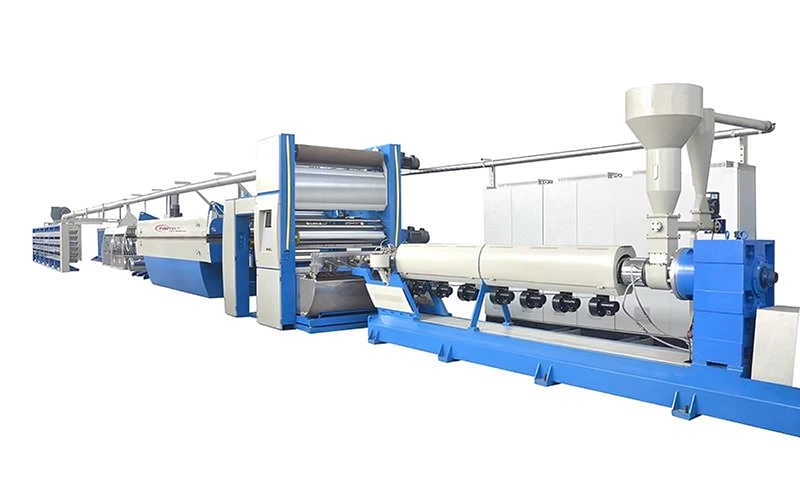
Choosing a plastic extrusion tape line for PP woven bags comes down to four inputs: the tape you must produce (width, thickness, denier), the tonnage your weaving floor actually consumes, the material you can reliably buy, and how the line will be wound and handed to the looms. Line speed is an outcome of those four, not the starting point. Get the order right, and most configuration questions answer themselves.
1. Start from the tape, not the machine
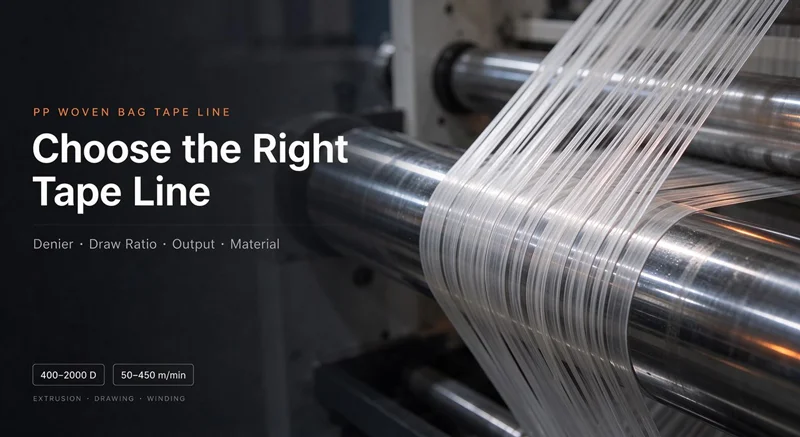
A flat tape is defined by three numbers: width, thickness, and denier. Denier describes the linear density of the yarn and is what the loom actually feels when it weaves; thickness and width determine how that denier is reached. Two plants can ask for the same line speed and need completely different machines because one runs 400 D yarn for light shopping bags and the other runs 1,500 D for cement sacks.
The mechanism that links them is drawing ratio — how much the film is stretched after quenching. Published figures on our tape line pages put the general-speed series at a drawing ratio of 4:1 to 12:1 and drawing speeds of 50–150 m/min, while the high-speed lines run a 5:1 to 8:1 ratio at 300–400 m/min with a 6 m oven. Higher ratio raises tenacity and lowers elongation; it also narrows the operating window. If your bag spec needs high tenacity at low denier, you need ratio headroom; if you run heavy tape and high filler loading, a moderate ratio with stable tension control matters more than a high one.
Practical rule we give buyers: write the target denier, thickness and drawing ratio on one line, then ask each supplier to state which of their models reaches it — and at what line speed. If a supplier quotes only speed, the answer is incomplete.
2. Material decides more of the configuration than the brochure does
Three material conditions change the machine, not the price list:
- Virgin PP/PE — the baseline. Standard screw, standard screen pack, predictable melt pressure.
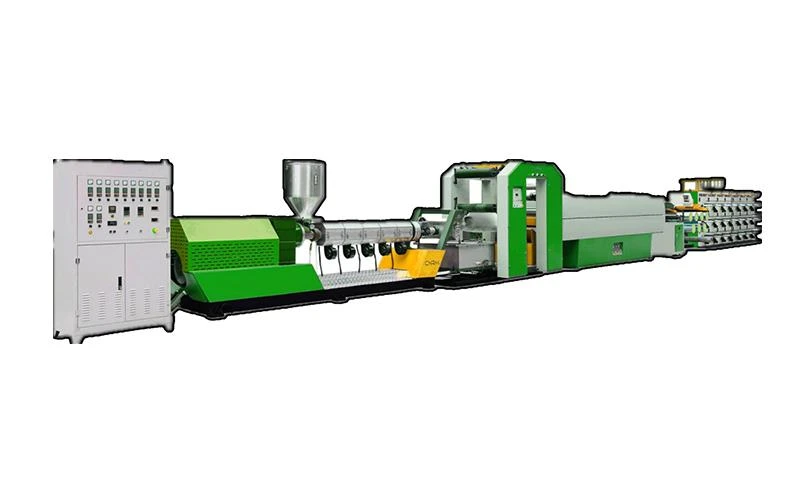
- Recycled (PCR) feedstock — melt pressure fluctuates because regrind density and moisture vary. A melt pump and an automatic screen changer stabilise pressure; edge-trim recycling and refeed reduce waste. Our lines are specified to run 100% post-consumer material, but "can run" and "runs steadily for a full shift" are different claims, so ask for the reference installation closest to your feedstock.
- High-fill calcium carbonate — filler raises viscosity and wear. The screw and barrel material becomes a durability question, not a detail: our extruders use 38CrMoAlA nitrided steel with a 33:1 L/D screw, which is the specification we point to when a buyer plans 20–30% filler loading. For the single-screw versions used with wide die settings, the PP raffia extruder specifications list die width from 600 mm to 1,000 mm and output up to 3,000 kg per 24 hours.
One caution worth repeating to buyers: a supplier who confirms recycled material without asking about your bale quality, moisture and flake size is answering a different question than the one you asked.
3. Size the line against loom consumption, not against the biggest number
Line capacity should be read together with die width, because die width sets how many tapes you split per pass and therefore the practical width of your product mix. Published ranges on our pages:
- General-speed series (SJ-FS/B): 50–700 kg/h, screw 115–210 mm, die width 800–5,800 mm
- 400 m/min high-speed line: 350–650 kg/h, screw 90–135 mm, T-die 850–2,000 mm
- 450 m/min high-speed line: 100–800 kg/h, die width 1,000–2,500 mm, tape thickness 0.02–0.15 mm
The arithmetic that matters: hourly tape output must cover the hourly tape consumption of your loom set, minus the waste you accept. Ask your loom supplier for kg/h per loom at your fabric width and pick-up rate, multiply by the number of looms you intend to run, then add changeover and start-up losses. A line sized exactly to the average will starve the looms on changeover days; a line sized to the peak will idle. If the two numbers are hard to reconcile, it is worth checking how tape output feeds circular weaving before fixing the extruder size.
Also check the published capacity condition. The 18 tons/day figure shown for our tape lines refers to a heavy cement-bag tape case — a light shopping-bag tape at the same line speed will not produce 18 tons. Treat every capacity number as "at this tape weight, this die width, this material".
| Criterion | General-speed series (SJ-FS/B) | 400 m/min high-speed line | 450 m/min high-speed line |
| Screw diameter | 115–210 mm | 90–135 mm | 110–140 mm |
| Max. line speed | 50–150 m/min drawing speed | 400 m/min | 450 m/min |
| Capacity | 50–700 kg/h | 350–650 kg/h | 100–800 kg/h |
| Die width | 800–5,800 mm | 850–2,000 mm | 1,000–2,500 mm |
| Tape denier | — | 400–2000 D | 400–2000 D |
| Tape thickness | — | — | 0.02–0.15 mm |
| Best fit | Wide product mix, high filler or recycled loading, moderate volume | High volume, single-product runs | Highest volume, tight thickness control |
To see the individual model sheets behind these ranges, review the available Plastic Extrusion Tape Lines configurations, or go straight to the general-speed SJ-FS/B General Speed Plastic Extrusion Tape Line series, the High Speed Plastic Extrusion Tape Line, and the high-speed tape line.
4. How to tell high-speed from general-speed in practice
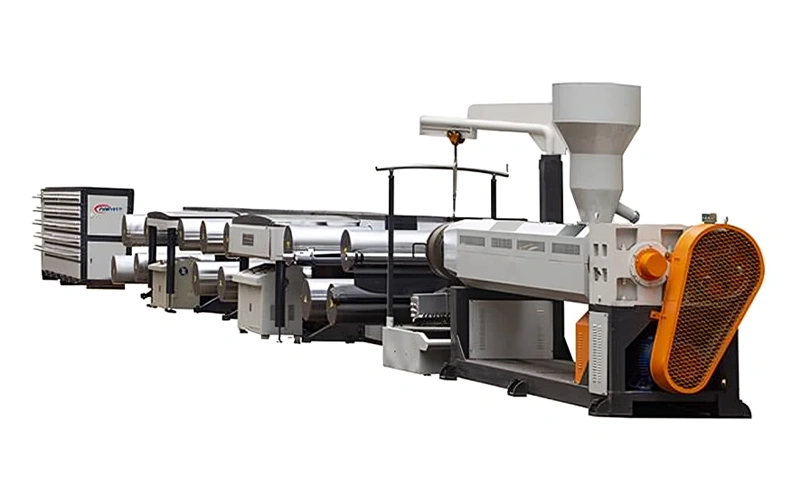
Speed class is not a badge; it is a set of supporting systems. A line that reaches 400–450 m/min needs three things a 100 m/min line does not:
- Thickness control in the loop — at 400 m/min a 0.01 mm drift becomes metres of out-of-spec tape before an operator notices. Our high-speed lines offer an online film thickness gauge with automatic die-lip adjustment as an option; without it the operator is chasing the die by hand.
- Non-stop winding — a six-group non-stop cutting unit plus an auto-winder is what keeps bobbin changes from stopping the line. On a general-speed line, manual bobbin handling is acceptable because the tape reserve buys time.
- Heat capacity in the oven — a 6 m hot-air circulation oven and ultra-efficient heating are what allow the stretch to complete at speed. Shorter ovens force the speed down or the tape quality down.
Conversely, if your plant runs a wide mix of bag types, or buys variable recycled feedstock, the general-speed range often gives a better return: lower installed power per kg, a wider die range up to 5,800 mm, and more tolerance for formulation changes. Buyers regularly ask which class pays back faster; the honest answer is that it depends on how many hours per day the line runs at its design tape, not on the nameplate speed.
5. Winding, dosing and the auxiliary loop
- Winder type and bobbin count — must match loom bobbin size, otherwise the tapes are re-wound before weaving.
- Gravimetric dosing and mixing — needed when filler or masterbatch ratio must be held; volumetric dosing drifts with regrind.
- Edge-trim recycle and refeed — recovers slit edge waste directly into the extruder.
- Melt pump and screen changer — pressure stability for PCR and fine filler.
- Industrial PC and power monitoring — gives kWh/kg visibility, which is the only way to verify an energy claim later. The measures behind that figure are covered in energy-saving measures on a tape line.
6. What to send in the inquiry
- Target tape: width, thickness, denier, drawing ratio
- Bag type and fabric weight per bag, so tape consumption can be estimated
- Number of looms and their kg/h consumption
- Material: virgin / recycled percentage, filler type and loading, masterbatch form
- Required hourly and daily output, shift pattern
- Available floor space and power supply; existing extruder if any
- Winding: bobbin size, taper or straight, automation level expected
- Destination and voltage/frequency, plus any certification or documentation requirement
A quotation that arrives without these items is a template, not an engineering answer.
Frequently asked questions
Is a higher line speed always better?
No. Speed only pays back when the line runs near its design tape for long hours. At low utilisation, or with frequent product changes, the extra heating power, thickness control and winding automation of a high-speed line cost more than they return.
Can one tape line serve both light shopping bags and heavy cement bags?
Usually not at the same settings. Tape weight, die width and drawing ratio differ enough that changeover becomes a production plan of its own. Plants with both products typically dedicate a line per family, or accept planned changeover windows.
What decides whether I need a melt pump?
Melt pressure stability. With virgin pellet and stable temperature control, a well-set screen pack is often enough. With PCR flake, high filler loading or very thin tape, the pump is what keeps thickness from drifting between batches.
How do I verify an energy consumption claim?
Ask for the measurement basis: kWh/kg at which tape weight, which line speed, which material, measured at the main incoming meter or estimated from motor ratings. Our published figure of 0.25–0.28 kWh/kg for mid-speed models is stated per kilogram of tape; without that basis, numbers are not comparable.
Do we have to buy the whole line at once?
No. Extruder, stretching, winding and dosing can be staged, provided the interfaces are fixed at the start — die width, winding speed and bobbin standard. Staging the winder or the dosing system later is common; changing die width later is not.
What is the realistic delivery and commissioning sequence?
On our standard terms, delivery is 30–45 days after deposit, with an engineer on site within one week of the foundation and utilities being ready. Buyers should confirm the installation scope in the contract rather than assume it.
Conclusion
The four inputs that decide the machine are tape specification, loom consumption, material condition and winding requirement. Avoid two common errors: reading capacity as a fixed number independent of tape weight, and buying speed you cannot utilise. Bring your denier, drawing ratio, filler loading and loom count to the discussion — those four lines of data are what turn a catalogue into a configuration. If you want the full picture of how this stage fits the rest of the plant, read the full production process overview, or discuss your material and output targets with our engineers.