How to Choose a Plastic Extrusion Tape Line for PP Woven Bags
 Nov 21,2026

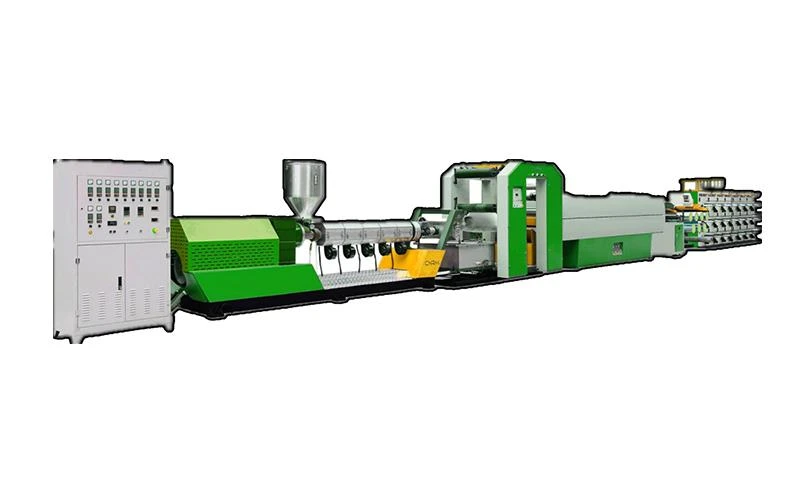
The difference between a general-speed and a high-speed tape extrusion line is not one number on a nameplate. It is a package: oven length, number of godets, screw speed, winding automation, and thickness control running in the loop. Compare that package against your product mix and your running hours, and the speed class usually decides itself.
1. Two different numbers are both called "speed"
Buyers often compare a 150 m/min line with a 450 m/min line and conclude the second one is three times more productive. That comparison mixes two measurements.
Drawing speed is how fast the tape leaves the stretching section. On our general-speed SJ-FS/B series, it runs 50–150 m/min. On the high-speed lines, it runs 300–400 m/min, with the fastest model rated at 450 m/min.
Screw speed is how fast the extruder turns. The general-speed series runs roughly 20–75 r/min depending on screw diameter; the high-speed lines run 60–120 r/min, and some 400 m/min models reach 132 r/min.
Both matter, and for opposite reasons. Raising line speed without raising extruder output simply stretches the same melt harder — tenacity and elongation move, sometimes in directions you did not ask for. Raising screw speed raises output but shortens melt residence time, which is why the high-speed extruders use a 33:1 length-to-diameter screw and, on most configurations, a melt pump to hold pressure steady.
Then there is drawing ratio, the setting that turns film into yarn. The general-speed range covers 4:1 to 12:1 — wide enough to move between light shopping-bag tape and heavy industrial tape on the same machine. The high-speed lines work in a 5:1 to 8:1 window, because dwell time inside a fixed 6 m oven limits how much ratio you can extract at 400 m/min. A narrower window is not a weakness; it is the trade you accept for throughput.
2. What actually has to change when you go up a class
Speed is bought as a system. Here is the comparison at subsystem level, using the configurations published on our tape line pages.
Drive and stretching — the high-speed lines use a direct drive motor with two stretching units. The 400 m/min high-speed plastic extrusion tape line configuration lists an eight-godet stretching section including an annealing unit as standard. Annealing is what keeps a high-ratio, high-speed tape from behaving like a spring on the loom.
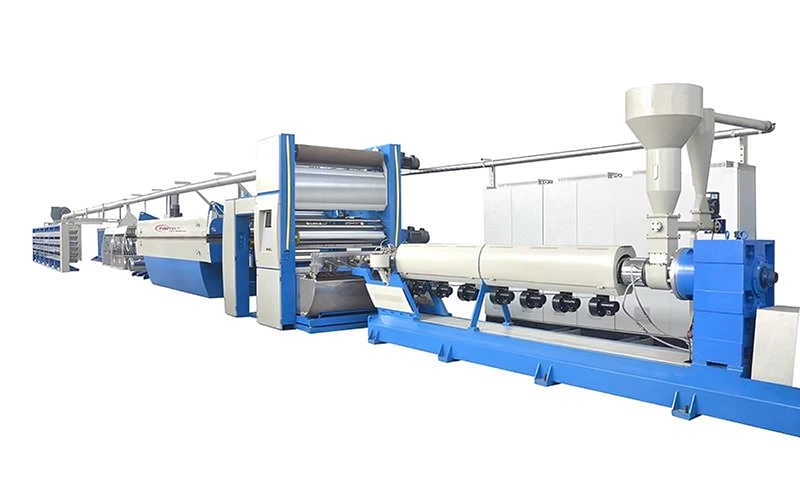
Oven — both high-speed classes use a 6 m hot-air circulation oven with ultra-efficient heating; on the 450 m/min models the oven heating power is listed up to 80 kW. A short oven at high speed forces you to choose between line speed and tape quality, which is the practical reason general-speed lines stay in the 50–150 m/min band.
Winding — this is where most plants feel the difference. The 400 m/min line lists a six-group non-stop cutting unit and an automatic winder; the 450 m/min high speed tape line model list carries an inverter-controlled high-speed winder. On a general-speed line, manual bobbin handling is tolerable because the tape reserve buys the operator time. At 400 m/min it does not.
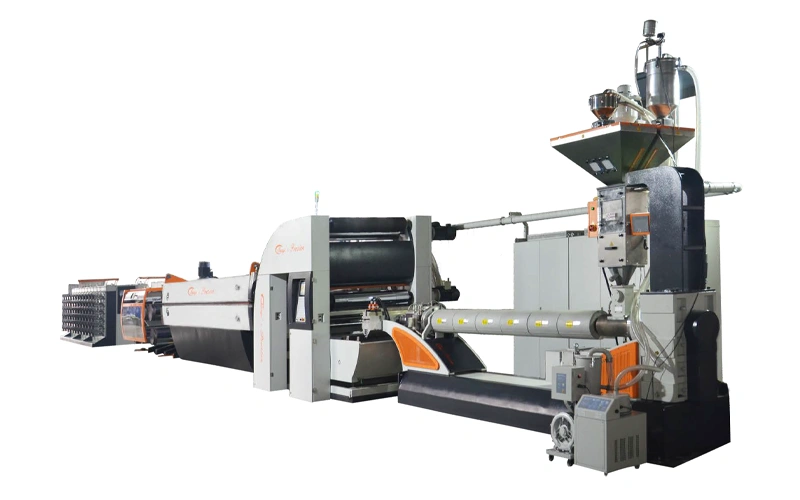
Thickness control — an online film thickness gauge with automatic die-lip adjustment is listed as an option on the 400 m/min line; the 450 m/min line lists an auto screen changer, melt pump and high-precision T-die among its line components. At speed, a 0.01 mm drift becomes metres of out-of-spec tape before anyone notices, so this is not a luxury item.
Dosing — gravimetric dosing and mixing is an option on the 400 m/min line; the 450 m/min line lists a powder material dosing and mixing system. Volumetric dosing drifts as regrind quality drifts, which matters most when you run recycled feedstock or high filler loading.
Footprint and weight — the general-speed range runs from about 11.3 × 1.5 × 1.3 m and 6.5 t at the small end to 30 × 8.5 × 2.5 m and 58 t at the largest die width. The 450 m/min range runs 40–52 m long and 35–50 t. A high-speed line is not only faster to run; it is much larger to house, and that shows up in foundation, crane access, and building length before it shows up in the invoice.
| Subsystem | General-speed (SJ-FS/B) | 400 m/min high-speed | 450 m/min high-speed |
|---|---|---|---|
| Drawing speed | 50–150 m/min | up to 400 m/min | 300–450 m/min |
| Screw speed | approx. 20–75 r/min | 20–132 r/min (model dependent) | 60–120 r/min |
| Drawing ratio | 4:1–12:1 | Confirm per model | 5:1–8:1 |
| Oven | heating power 15–70 kW | 6 m hot-air circulation | 6 m hot-air circulation, up to 80 kW |
| Stretching section | conventional | 8 godets incl. annealing (standard) | confirm per model |
| Winding | manual bobbin handling | six-group non-stop cutting + auto winder | inverter-controlled high-speed winder |
| Thickness control | — | online gauge + auto die lip (option) | auto screen changer, melt pump, high-precision T-die |
| Extruder motor | 30–185 kW | Confirm per model | 110–220 kW |
| Footprint/weight | 11.3–30 m long, 6.5–58 t | Confirm per model | 40–52 m long, 35–50 t |
Several cells read "confirm per model" on purpose. Stat sheets are written per model, and a comparison table that fills every cell by averaging is how buyers end up specifying the wrong machine.
3. Where each class earns its money
General-speed, when the product mix is wide. Die width from 800 to 5,800 mm and capacity from 50 to 700 kg/h let one machine cover several bag families, and the 4:1–12:1 ratio range does the same for tape weight. Filler loading and variable recyclate are easier to absorb here, and installed power is the lowest of the three — extruder motors from 30 to 185 kW on the general-speed SJ-FS/B General Speed Plastic Extrusion Tape Line range.
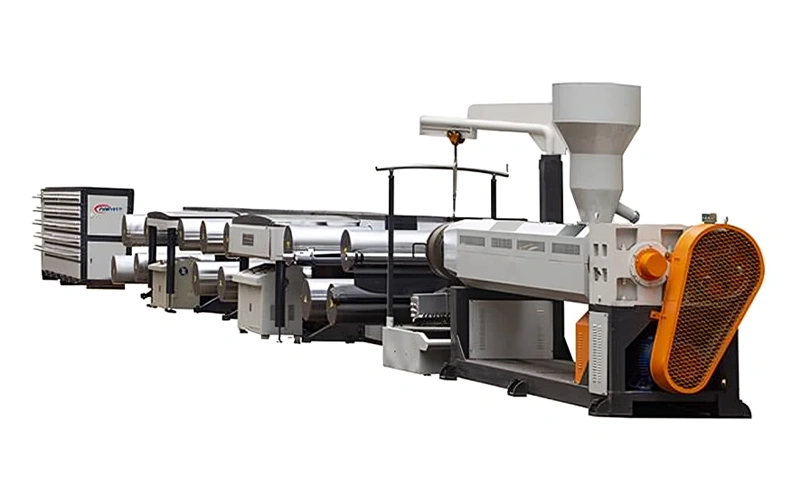
400 m/min, when one product runs long. 350–650 kg/h with T-die widths from 850 to 2,000 mm. This class exists for plants whose bottleneck was bobbin changes and oven dwell, not for plants that change bag spec twice a week.
450 m/min, when volume and tolerance meet. 100–800 kg/h, die width 1,000–2,500 mm, tape thickness 0.02–0.15 mm, denier 400–2000 D. It bundles the most automation by default and takes the most floor.
4. Decision matrix
| Your situation | Lean toward | Because |
|---|---|---|
| One bag family, line runs 20+ h/day at design tape | 400 or 450 m/min | Capital is amortised over running hours, not over capacity |
| Several bag types, frequent spec changes | General-speed | Ratio and die range absorb changeover; over-speed capacity sits idle |
| High calcium carbonate loading or unstable recyclate | General-speed, with melt pump and screen changer | Wider operating window, lower screw speed, easier pressure control |
| Building length or crane capacity is fixed | General-speed | A 40–52 m footprint does not fit everywhere |
| Labour cost is the main operating pain | High-speed | Non-stop winding removes most bobbin-handling attendance |
| Tight denier tolerance is contractual | High-speed with online thickness control | Closed-loop die adjustment is the only way to hold it at speed |
5. Cost items that never appear in the quotation
- Electrical connection. Extruder motor 30–185 kW across the general range against 110–220 kW on the 450 class, plus oven heating. Transformer capacity is a project cost, not a machine cost.
- Foundation and lifting. A 35–50 t line moves differently from a 6.5 t one.
- Wear parts at higher rpm. Screws and barrels are 38CrMoAlA nitrided steel; higher screw speed and abrasive filler shorten the interval between rebuilds. Ask for the wear-part list and lead time before signing.
- Scrap during changeover. A high-speed line produces out-of-spec tape faster. Changeover procedure and ramp-up time belong in the comparison.
- Idle capital. Running a 450 m/min machine at 200 m/min for light tape is an expensive way to buy a large footprint.
6. A fair comparison protocol
Ask both suppliers the same six questions, in writing:
- kWh/kg — at which tape weight, which drawing speed, which material, and metered at the main incomer or estimated from motor ratings?
- Denier tolerance — what is guaranteed, and how is it measured, online gauge or lab sample?
- Break rate — what do they expect per tonne at design speed on your material, and what is the reference installation?
- Bobbin change — non-stop winding yes or no, and what is the changeover time?
- Spec change — which parts must be re-set between two tape specs (die, godets, oven zones, winding), and how long does it take?
- Site — footprint, machine weight, installed power, oven clearance, and commissioning scope.
Answers that come back vague on items 1, 2 and 3 are usually the answers that will be argued about after installation.
Frequently asked questions
Is a high-speed line cheaper per kilogram?
Only when it runs. Energy per kilogram is a function of tape weight, line speed and material, not of the class name. Our published figure of 0.25–0.28 kWh/kg refers to mid-speed models, and the high-speed lines rely on efficient heating and a 6 m circulation oven to avoid a proportional energy penalty at speed. Ask for the measurement basis before comparing any two numbers.
Do I really need the online thickness gauge?
At 400 m/min and above, yes if denier tolerance is part of your customer specification. Below that, manual die adjustment still has time to react.
Can one line run both recycled and virgin material?
Our tape lines are specified to run 100% post-consumer material as well as virgin resin. The practical question is feedstock consistency: flake size, moisture and filler loading vary, and a melt pump with an automatic screen changer is what keeps thickness stable between bales.
How many circular looms can one tape line feed?
There is no general answer. It depends on the kg/h each loom consumes at your fabric width and pick-up rate. Multiply that by your loom count, add changeover losses, and compare with the tape output at your actual tape weight — not at the headline capacity.
Can a general-speed line be rebuilt into a high-speed one?
Not as a bolt-on. Oven length, godet count, winding automation and drive sizing all change together. Treat a speed upgrade as a new line decision rather than a modification.
Conclusion
Speed class is a package decision: drawing speed, screw speed, oven, stretching, winding, and thickness control move together, and footprint and power move with them. Match the package to your product mix and running hours first, then check the six answers in writing. If you want the selection logic that comes before this comparison — tape spec, loom consumption, material condition — read how tape specification drives line sizing. When you are ready to compare against real configurations, review the plastic extrusion tape lines range, or send us your tape spec and running hours.
Related reading
- How to Choose a Plastic Extrusion Tape Line for PP Woven Bags
- 5 Proven Ways to Reduce Energy Consumption on Your Tape Extrusion Line
- PP Woven Bag Production Line: Process, Equipment and Configuration
- Why 100% Recycled Material Is the Future of the Plastic Woven Industry
- 6-Shuttle vs 4-Shuttle Circular Loom: Speed, Energy, and ROI Comparison