How to Select a Circular Loom by Shuttle Count and Fabric Width
 Nov 25,2026

A circular loom is sized by the fabric it has to weave, not by the shuttle count in its name. Work backwards: bag or fabric width → folded cloth width → warp capacity at your density → picks per minute → model. Shuttle count then explains how fast that width can be woven, and what the machine costs in power, height, and floor space.
1. What shuttle count changes actually
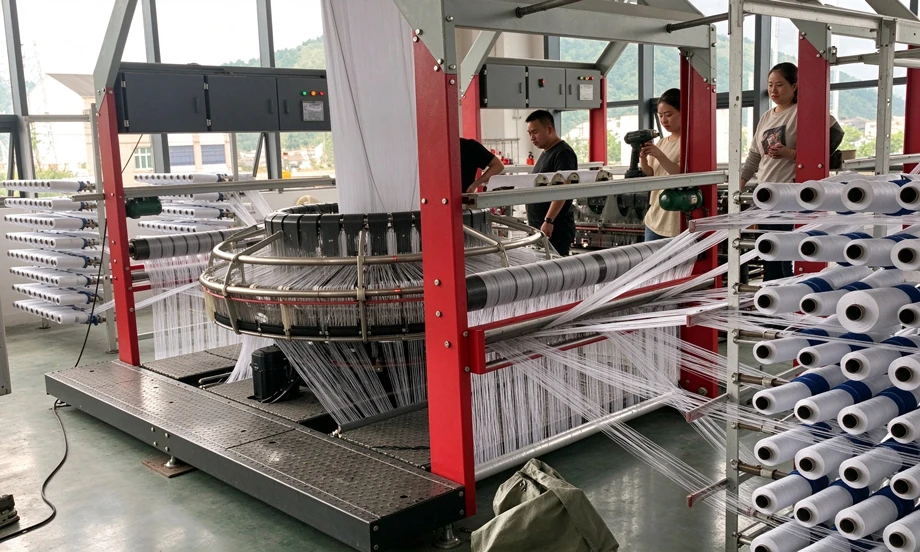
A circular loom inserts one pick per shuttle per revolution, so the picks per minute follow a simple product:
picks per minute = main motor revolutions per minute × number of shuttles
Published figures on our loom pages show why this matters more than the shuttle number alone. The NY-SBY-850/6 Plane Cam Six Shuttle Circular Loom runs 90–180 r/min, which is 540–1,080 picks per minute; its quoted weaving capacity is 1.8–2.7 m/min. The NY-YZJ-750/4 Small Cam Four Shuttle Circular Loom reaches 180 r/min, or 720 picks per minute.
Now look at what happens as the machine grows:
| Shuttle count | Example model | Folded cloth width | Main motor speed | Picks per minute |
|---|---|---|---|---|
| 4 | NY-YZJ-750/4 | 300–750 mm | 180 r/min | 720 |
| 4 | NY-YZJ-1500/4 | 900–1400 mm | 120 r/min | 480 |
| 6 | NY-SBY-850/6 | 300–850 mm | 90–180 r/min | 540–1,080 |
| 6 | NY-SBY-1200/6 | 800–1100 mm | 140 r/min | 840 |
| 8 | NY-SBY-2300/8 | 1800–2200 mm | 75 r/min | 600 |
| 10 | NY-SBY-2600/10 | 2200–2550 mm | 65–75 r/min | 650–750 |
| 12 | NY-SBY-3400/12 | 2900–3300 mm | 50 r/min | 600 |
Two things stand out. First, picks per minute does not scale with shuttle count — a twelve-shuttle loom at 50 r/min inserts 600 picks per minute, less than a six-shuttle at 180 r/min. Second, the rpm falls because the machine is carrying wider fabric, heavier shuttles and a bigger cam or belt drive. Shuttle count buys picks per revolution; width and mass take them back.
So the honest question is not "how many shuttles", it is "at what width do I need how many picks per minute". A standard bag fabric at roughly 10 picks per inch consumes about 394 picks per metre, which is why a 1,080 picks/minute loom lands near 2.7 m/min of fabric. If your construction is 12 picks per inch, the same loom produces proportionally less.
2. Folded cloth width is the number that decides the model
A circular loom weaves a tube. Folded cloth width is that tube laid flat — in effect half the circumference. Everything else follows from it:
- Flat bag of width W — folded width is roughly W plus the sealing or sewing allowance. A 500 mm bag lands in the 300–750 mm range, not at the top of a wide loom.
- Gusseted bag — the gusset adds to the circumference, not to the flat width, so calculate the full perimeter before choosing.
- FIBC and tarpaulin — these are fabric products rather than bag widths, so specify the finished fabric width and let the model's folded range decide.
| What you weave | Required folded width | Models in range |
|---|---|---|
| Small bags, 300–500 mm | 300–750 mm | NY-YZJ-750/4, NY-SJ750/4C, NY-SBY-850/6 |
| Standard bags, 500–850 mm | 300–850 mm | NY-SBY-850/6, NY-YZJ-750/4 |
| Medium bags, 800–1100 mm | 800–1100 mm | NY-SBY-1200/6, NY-YZJ-1200/4 |
| Large bags, 1100–1400 mm | 900–1450 mm | NY-YZJ-1500/4, NY-SBY-1500/6 |
| Jumbo/geotextile, 1500–1900 mm | 1500–1900 mm | NY-SBY-2000/8 |
| Wide jumbo/tarpaulin, 1800–2250 mm | 1800–2250 mm | NY-SBY-2350/10 |
| Ultra-wide fabric, 2200–2550 mm | 2200–2550 mm | NY-SBY-2600/10 |
| FIBC, U-panel, tarpaulin, 2700–3300 mm | 2700–3300 mm | NY-SBY-3200/12, NY-SBY-3400/12 |
Then check the second number: the maximum number of warp ends. Warp capacity has to cover the whole circumference, so:
warps per inch = max warp ends ÷ (2 × folded width in mm ÷ 25.4)
Take the NY-YZJ-1500/4 Small Cam Four Shuttle Circular Loom width and warp table: 1,120 warp ends over a 1,400 mm folded width means a 2,800 mm circumference, about 110 inches, which is roughly 10 warp ends per inch. That is a normal bag construction. If your buyer specifies 12 × 12, the required warp count rises by about a fifth, and you either move up a model or accept a lower density. This is the check most quotations skip, and it is the reason a loom "within the width range" can still fail on fabric quality.
Two more numbers belong in the same check: maximum warp bobbin diameter (110–130 mm on our models, which sets how long you run between bobbin changes) and maximum winding diameter (1,200–1,500 mm, which sets the fabric roll size your conversion line can handle).
3. Common shuttle counts and where they land
Four shuttles cover 300–1,400 mm folded width across three models at 120–180 r/min, 640–1,120 warp ends. They weave standard bags, leno mesh and geotextiles, and accept flat yarn of varying quality, including completely recycled material. A suspension version, the NY-SJ750/4C Latest Suspension Four Shuttle Circular Loom, raises main motor speed to 210 r/min with a quoted capacity of 120–130 m/h.
Six shuttles start at 300 mm and reach 1,450 mm folded width, at 90–180 r/min. This is the workhorse band for standard industrial bags; a six-shuttle at 180 r/min is what our pages describe as 30–50% faster than a four-shuttle at comparable width.
Eight and ten shuttles move into 1,100–2,550 mm folded width at 65–75 r/min, with 1,344–3,024 warp ends. Jumbo bags, geotextiles and tarpaulins live here; the Six/Eight/Ten Shuttle Circular Loom model table carries the per-model widths and footprints.
Twelve shuttles reach 2,700–3,300 mm at 50 r/min, 3,840–4,224 warp ends, and a 18.5 kW main motor, as listed on the twelve-shuttle FIBC models. FIBC, U-panel fabric and wide tarpaulin are the targets. A twelve-shuttle is not a "faster six-shuttle"; it is a wider machine that turns slower.
4. What the width decision costs outside the invoice
- Floor space. The four-shuttle 750/4 occupies about 8.5 × 2.2 × 3.3 m and weighs 1,600 kg. The twelve-shuttle 3400/12 occupies 19.5 × 5.4 × 6.3 m and weighs about 12,000 kg.
- Building height. Six metres plus is not available in every shed, and the lift-up mechanism needs clearance above the loom.
- Power. Main motor 2.2 kW on the small four-shuttle against 18.5 kW on the twelve-shuttle, plus warp infeed and winder motors. Loom count multiplies this; it belongs in the transformer calculation, not the machine budget.
- Yarn logistics. A 3,024-warp loom consumes bobbins far faster than a 768-warp one. Creeling space and bobbin transport are part of the layout.
5. Where yarn and fabric type override the arithmetic
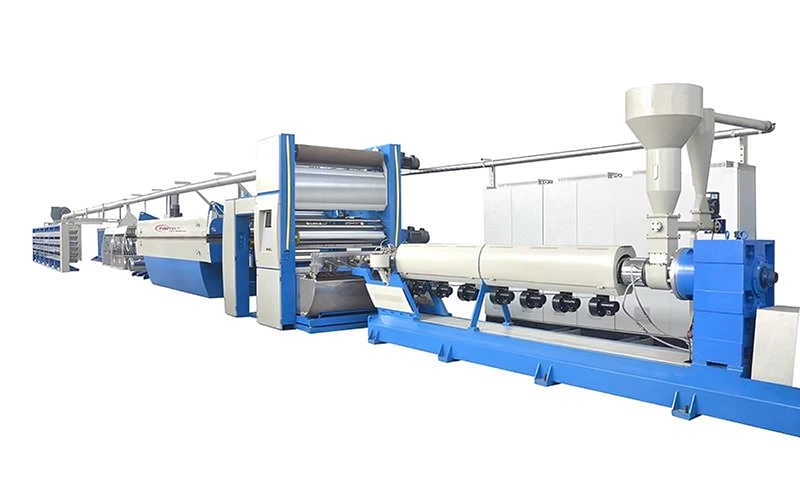
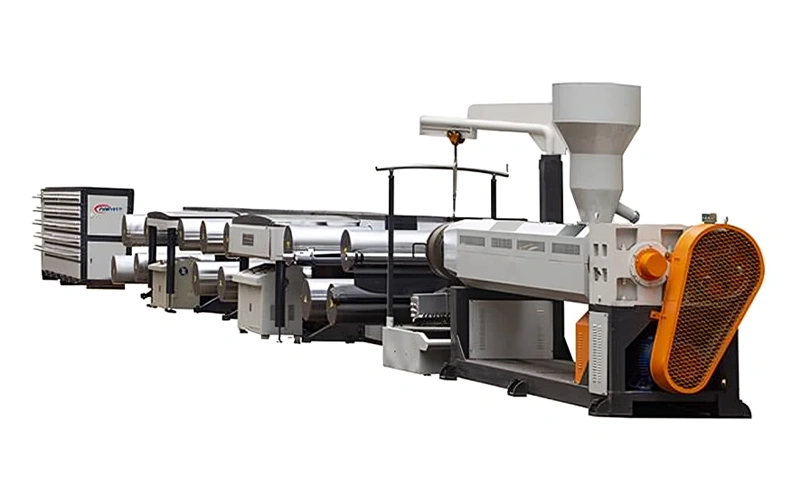
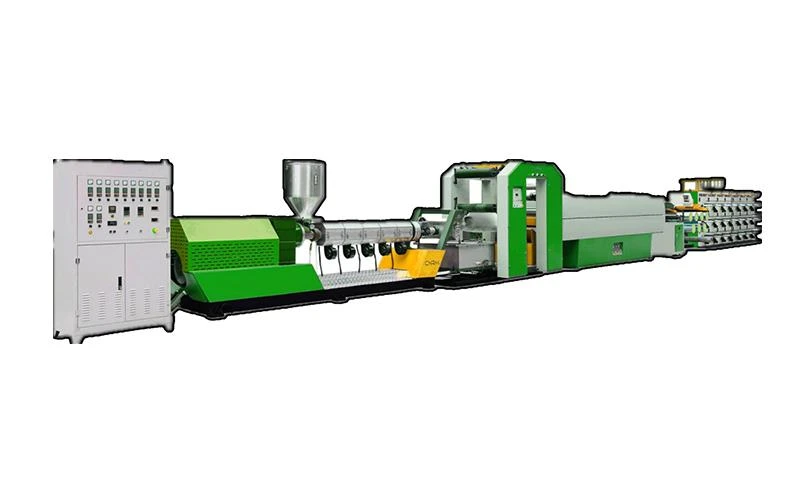
The loom does not decide the fabric alone. Tape width and denier come from the extrusion line, and the loom's warp capacity must be read against the tape you actually feed it: wider tape at the same warp count gives a heavier fabric at the same density. The plastic extrusion tape lines range covers denier from 400 to 2,000 D, and the same tape spec sits in the loom's warp and weft bobbins, so the two stages are best specified together rather than bought separately.
Two fabric families sit outside this width logic and should not be forced into it: leno mesh bags are woven on a dedicated mesh loom, and Raschel mesh on a knitting machine. If your product mix includes both woven bags and mesh, that is a second machine decision, not a configuration of the first.
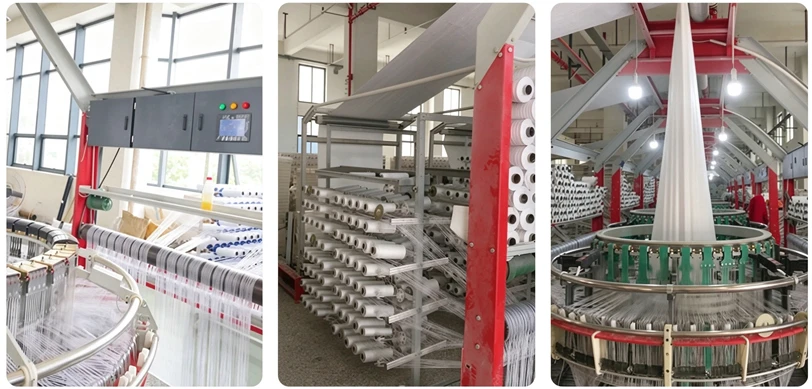
6. Selection information checklist
- Bag or fabric type, and whether it is flat, gusseted, tubular or U-panel
- Finished width and length, plus gusset or perimeter dimensions
- Construction: warp and weft ends per inch, and target fabric weight per square metre
- Tape spec feeding the loom: width and denier
- Daily fabric output required, and how many hours per shift the loom runs
- Fabric roll diameter your conversion or printing line accepts
- Building height, floor area per loom and available power
- Whether the plant also needs mesh, hose or FIBC fabric on the same floor
Frequently asked questions
Does a higher shuttle count always mean higher output?
No. Picks per minute is revolutions × shuttles, and revolutions fall as the machine widens. A twelve-shuttle at 50 r/min delivers fewer picks per minute than a six-shuttle at 180 r/min; what it delivers is width.
Can one loom weave both 500 mm bags and FIBC fabric?
Not practically. A twelve-shuttle is built for 2,700–3,300 mm folded width; a small four-shuttle covers 300–750 mm. Running far below the design width wastes the machine, and running above the model range is not an adjustment.
How do I know the loom can hold my fabric density?
Divide the maximum warp ends by the circumference in inches. If the result is below your required ends per inch, you need a model with more warp capacity, not a higher line speed.
Will a four-shuttle loom run 100% recycled tape?
Our four-shuttle series is specified for flat yarn of varying quality, including completely recycled material. Consistency still depends on tape quality from the extrusion line, which is why the two stages are usually specified together.
What is the practical effect of the suspension system?
On the NY-SJ750/4C it raises main motor speed to 210 r/min and protects the yarn from being pressed by the shuttle wheel, with a quoted capacity of 120–130 m/h at 300–750 mm folded width.
Conclusion
Width first, density second, speed last. Convert the bag or fabric into folded cloth width, check warp capacity against your construction, then read what the model's rpm and shuttle count actually deliver in picks per minute. Shuttle count is a consequence of that calculation, not an input to it. If you have the bag dimensions and construction in hand, review the circular loom machine range, or send both to our engineers with the tape spec you plan to run.